
I was born in the 1980s, so a few years ago, when Stranger Things became all the hype on Netflix, it was an instant shot of nostalgia.
The music, the mall, the clothes, and the innocence of being young took me back to that period. A time when life was good. Apparently, it wasn’t just me. Stranger Things took a lot of us back to that time. Kate Bush’s Running Up That Hill (originally released in 1985) became one of the most streamed songs on Spotify in 2022.
One of the central elements that brings the group of friends together in Stranger Things is the popular role-playing game, Dungeons and Dragons.
Like Bush’s song, Dungeons and Dragons has enjoyed a shot of resurgence in part due to the popular show. Today, the Subreddit r/DnD has 4.1 million members (ranked #191 in size of nearly 130,000 active subreddits). Hasbro, the parent company of Wizards of the Coast, which owns DnD, posted over a billion dollar profit in 2023.
DnD is a very popular game, indeed.
Given the rise of RPGs (role playing games) recently, I have grown fascinated with the game (I’ll admit, I didn’t play the game when I was younger). I’ve bought some of the books from a local used bookstore along with the game’s starter kit. I’ve watched YouTube videos. I’ve talked to friends who play. One of the summer “challenges” I have for my own kids is to learn a few new games. DnD is on that list.
As I’ve taken the last year to learn the mechanics of the game, a thought has become more salient over that time: Could I create an RPG to play in a class to illustrate a real world scenario? I love to make my classes more engaging, relatable, but also fun. There’s a lot of research and discussions that illustrates that when students are engaged, they retain more knowledge, and RPGs give students a “lab” (for a lack of better words) to test their decisions in a situation.
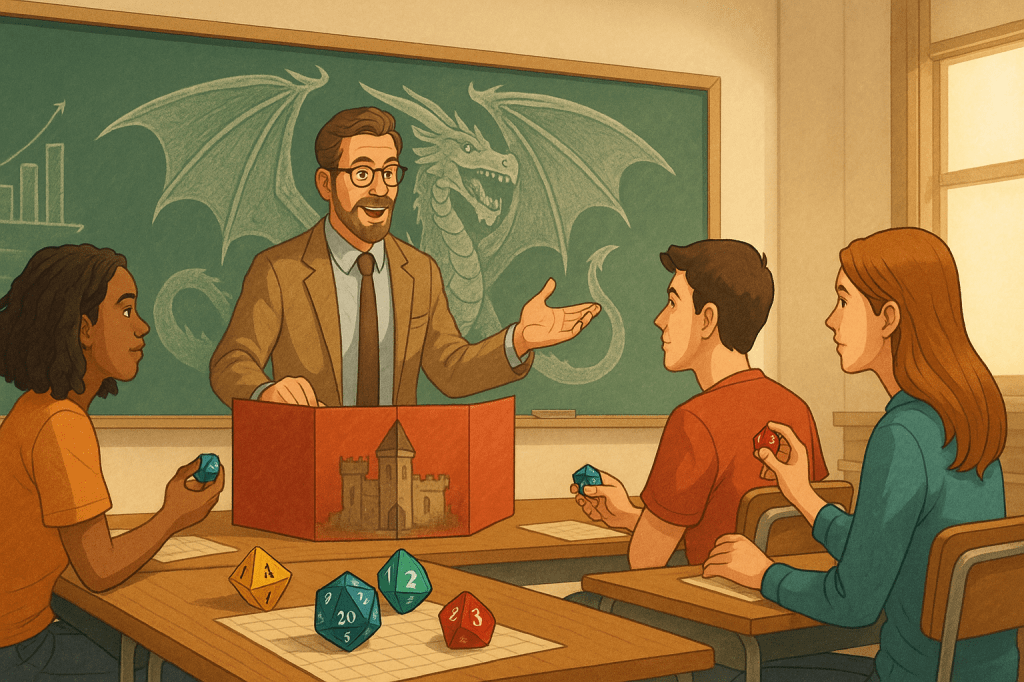
I went to AI (in this case, Chat GPT) and asked it for help drafting an RPG I can use to teach Healthcare Administration students real world scenarios. After some tweaking, though less than I expected, Chat GPT was able to help me develop a great RPG for my students. The output gave me a few different ideas for the main “story” of the RPG. The characters in the game were what you would expect in a healthcare setting: healthcare administrators, patients, clinicians, hospital staff, and other supporting characters. Dice rolls dictate the actions of characters, the game master (think of the director who coordinates/directs the game) would be the instructor, who is familiar with the storyline, as well as all elements of the game.
I plan on using the game this Fall with one of my courses. The setting is a fictional healthcare system dealing with a budget shortfall, a staffing crunch, and an unexpected PR crisis. Students will step into roles as administrators, clinicians, and support staff, making decisions with real consequences tied to outcomes.
My hope is that this makes the complexity of healthcare administration more “real” and hopefully a little fun. At the very least, it gives students a way to wrestle with tough choices in a setting that feels safe to them, where I can also help guide their thought processes.
If you’re thinking about trying something like this in your class, there’s very little you actually need to buy. If, like me, you prefer something tangible, the only real purchase is a few sets of dice for students to share. Most RPGs use a standard set: a four-sided die, a six-sided die, an eight-sided die, a ten-sided die, a twelve-sided die, and a twenty-sided die. If you’d rather go digital, you can use virtual dice here. Beyond that, the only thing you’ll need is a bit of time to tailor your game.
Turns out, all you really need is a few dice, a good scenario, and a willingness to play.
Let us know if you’ve played around with RPGs in your class. We’d love to hear from you!
Image for this post was created using ChatGPT.

 Tenure and Tech
Leave a comment